

Some while ago, an injection moulder from the UK telephoned us. He produces medical devices to administer drugs against diabetes and lung diseases. And he wants to know: can Oxipack test whether their transport packaging is really airtight? The semi-finished products cannot get contaminated by surrounding damp air.
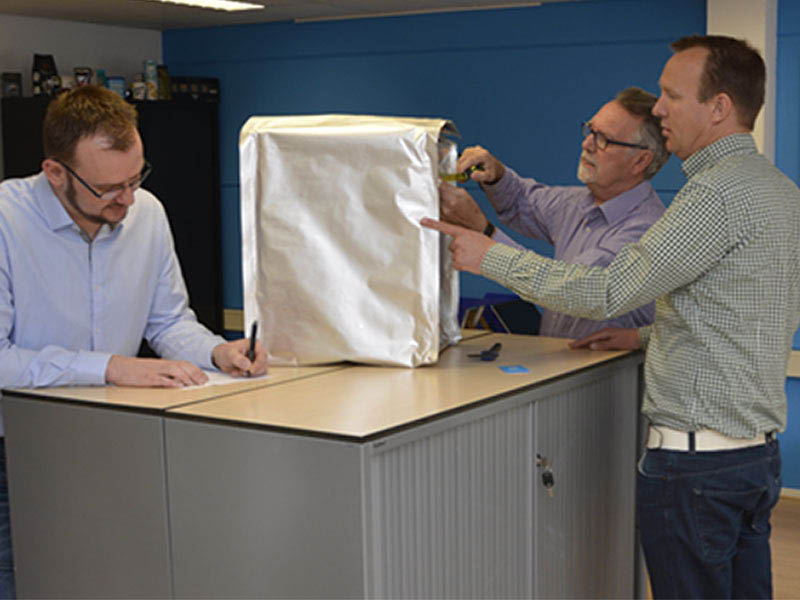
After this phone call the courier delivers a few solid aluminum foil packings of approx. 18 x 22 x 25 inch. Quite a bit larger and differently shaped than we normally test: this one is cube-shaped, with all kinds of folding ledges. And at the same time flexible. In technical terms: a quadruple stand-up pouch – with four upright sealed edges.
Some of the packages are filled with several large hard plastic parts, other ones with a mass of small particles. These all need to reach the pharmaceutical manufacturer in optimal condition in order to be assembled and filled with medicinal drugs. The injection moulding factory wants to prevent the semis to come into contact with ambient air during transport and storage. The packaging should be airtight and shield its contents against moisture and germs.
Can this be tested?
Within our office a small discussion follows: is this a feasible project? And can various fillings – ranging from rigid to quite flexible – be tested using the same device? The standard Oxipack Leak Tester tests flexible bags and cannot be used for this type of packaging. The medical injection moulder requires a leak detection solution tailor made. Because of the large dimensions and the folding of the foil this packaging can’t be tested in the conventional way: using a bubble leak tester. The bubbles would remain at or in its folds.
A challenge for us: is it possible to test if this big cubical overwrap is airtight? And if so, what would be the measurement accuracy?
We outline a design and report back, “we will succeed.”
A prototype to start with
The client agrees to creating a prototype with a rectangular bell jar tailor made. This way, the client can see that it is feasible to detect tiny holes down to 50 microns – the required accepted criteria. Which is extremely accurate for this type of package sizes. It even is possible to be accurate to within 25 microns. Serge Smit: “I do not think any other company might achieve this kind of precision in testing this kind of volume.”
Obviously the previously sent packages are being tested. And guess what? According to the prototype tester, three of the four packages that were sent, are leak. Therefore, the sealing part of the packaging process will have to be checked thoroughly. For the client this preliminary result means an additional confirmation of the need for leak testing.
Pack Leak Tester XXXL
Especially for the medical producer a rectangular bell jar is developed, combined with a cubical membrane. The bell jar lowers down around the pouch, pulls a vacuum and then measures the pressure to detect leaks.
Sixteen weeks later, this design is ready and set to the desired level of accuracy, depending on the durability requirements. With the same accuracy the leak tester tests each kind of filling, it doesn’t matter whether the package is large or small.
The new Leak Tester XXXL – type OX0500 – reaches almost to the ceiling of the workshop. It measures practically 8 feet high and weighs 400 kg (4 cwt). It is by far the largest stand alone leak tester designed by Oxipack. And we immediately did build two because the injection moulder has a double packaging lin
Double check
This device has an extra built-in security, to meet the strict quality requirements of the medical industry. After each test cycle, the apparatus itself will also be measured, by checking the diaphragm. This works as a double check and additional calibration: when a leak is observed, it is 100% sure it’s the packaging that leaks – and not the membrane.
Demonstration in still empty hall
The two ‘giants’ are sent in special shipping crates to the medical injection moulder factory in England. Oxipack visits the factory site to install the XXXL leak tester and give instruction during commissioning. A good, airtight test package was send along as well to demonstrate the effect. And a dummy with a calibrated leak of 50 microns. The new production site appears still virtually empty at arrival! The required compressed air is not yet present, which is solved with a temporary pump. The operations manager joins us during the acceptance test and is quite pleased. Especially because the simultaneously installed sealing device can be validated directly. And the new foil thickness appears to differ. So there are still a few test rounds needed …
What does this milestone mean to Oxipack?
Serge Smit: “By developing this specific leak tester we proved that we can handle all types of challenges. So I dare say: Bring it on, challenge us! With our knowledge and expertise we are able to find a solution to the client’s needs. ”
How large packaging Oxipack can actually test? “Try us. We can test really big bags.”
Can it get any bigger? “It might. If necessary, we might even test entire shipping containers on air-tightness – using a yet different process. But whether it is necessary? Time will tell.”