

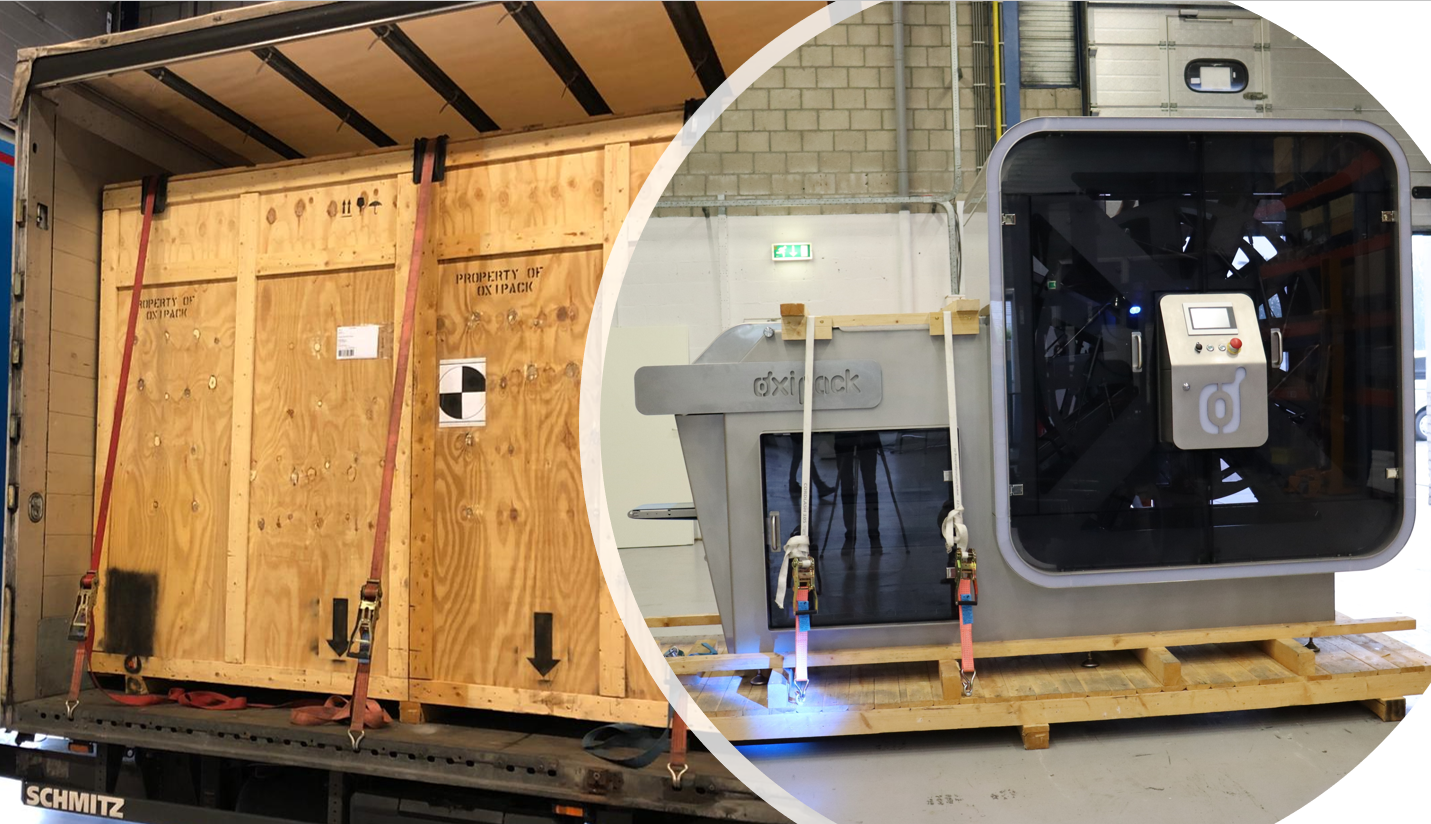
 Our project manager Joris has visited a customer in the DACH area (Germany, Switzerland and Austria) who has rented the Rotator for a two-week test at their production site. The customer specializes in packing meat products, and their focus on the highest possible quality has brought them to Oxipack. The customer wants to learn whether Oxipack can perform 100% automated in-line leak testing on their products. The 2-week demo gave the customer a taste of what it is to work with the highly accurate, 100% in-line Rotator.
Because meat is a delicate product, the customer uses MAP (modified atmosphere packaging). With gas, they eliminate the oxygen from their packaging completely. To make sure the oxygen does not re-enter the packaging, it should be leak-tight.
They use gas-based leak detection methods; these solutions are for more than one packaging in one chamber. This way, they cannot understand which pack is leaking. It was checking six packs at the same time, and six packs are rejected instead of one. Then they have to figure out which of the six is leaking or all have to be thrown away. They have to invest a significant amount of time in finding the leaker. On top of that, the test result is not always accurate.
The current leak detection control methods of the customer consist of several interconnected systems, which results in a significant amount of manual labor. Using the Rotator is highly advantageous in that regard because they can replace these multiple leak detection elements and a significant amount of labor with just one automated machine that runs at high speed. Every single pack is placed in a separate chamber, and only the leaking package will be rejected. Moreover, with the same accuracy, different sizes of packs can be tested simultaneously without any change to the chambers.
During the visit, the Oxipack project manager explained the vacuum decay method on-site to the customer. This helped the customer to understand how to validate the system and analyze the vacuum decay method. All in all, the weeks of testing were a success: it gave the customer insight into their packaging performance, and we look forward to taking the next steps together!