

We often use this term, but what does non-destructive leak testing really mean? Non-destructive testing is used to examine the quality of an object without damaging the object. Abbreviated, we refer to this method as NDT.
At Oxipack, an object represents a package, as we test packages for leaks. With this method, we are able to examine the quality of your packaging, without damaging your packaging. Consider, for example, food packaging, to reduce food waste. But also, for example, pharmaceutical packaging, cosmetic packaging or other types of packaging. To test the integrity of these different packages, we use non-destructive leak testing, because this method leads to lower costs and less waste.
But how? Let’s explain. Currently, many packaging is tested in the traditional way, where a package is thrown away afterwards, even if a package is good. If we assume that this happens at an average of 4-8 packs per hour, per production line, we can assume that this creates a huge amount of waste worldwide. From a sustainable and zero waste perspective, we came up with a solution. Instead of destructive testing for leaks, use non-destructive leak testing to test the quality of your packaging.
THE BENEFITS OF NON-DESTRUCTIVE TESTING
Packaging NDT has many benefits. Our non-destructive leak testers count the following:
- Products and packaging remain undamaged and dry. So these products no longer need to be destroyed after a test where no leak was found.
- It reduces waste within the production line.
- It reduces rejection further down the chain.
- Water no longer needs to be present in the industrial environment.
- A non-destructive leak testing machine can pay for itself in as little as a year (depending on a number of facts), which means you will end up with much lower costs over the long term.
- The machines are easy to operate, a green light indicates a leak-tight packaging, a red light shows the presence of a leak.
- The machines give accurate and traceable measuring results.
- With a robust design, so perfect for use in an industrial environment.
NON-DESTRUCTIVE LEAK TESTING METHODS
At Oxipack, we use different ways of non-destructive testing. For most packaging, for example flexible or rigid packaging, we use the ASTM F2238-09 Standard Test Method, called the vacuum decay method.
In addition to flexible and rigid packaging, there is vacuum packaging, which can also be non-destructively tested. Our Vacuum Leak Tester is used for non-destructive leak testing of dry vacuum packaging, for example for coffee packs or yeast packaging. In short, a clock head pushes the FDA approved custom-made membrane around the package to detect leaks. Products are also frequently vacuum-sealed packed, for example vacuumized sausages or vacuumized cheese with a very small amount of moisture present in the package. The Vacuum-Sealed Leak Tester is used for these packages. An insert is developed in the exact form of the vacuum-sealed packaging, in which the packaging is placed. The package is brought to a deeper vacuum, and in this way air is released from inside of the package, allowing a leak to be found.
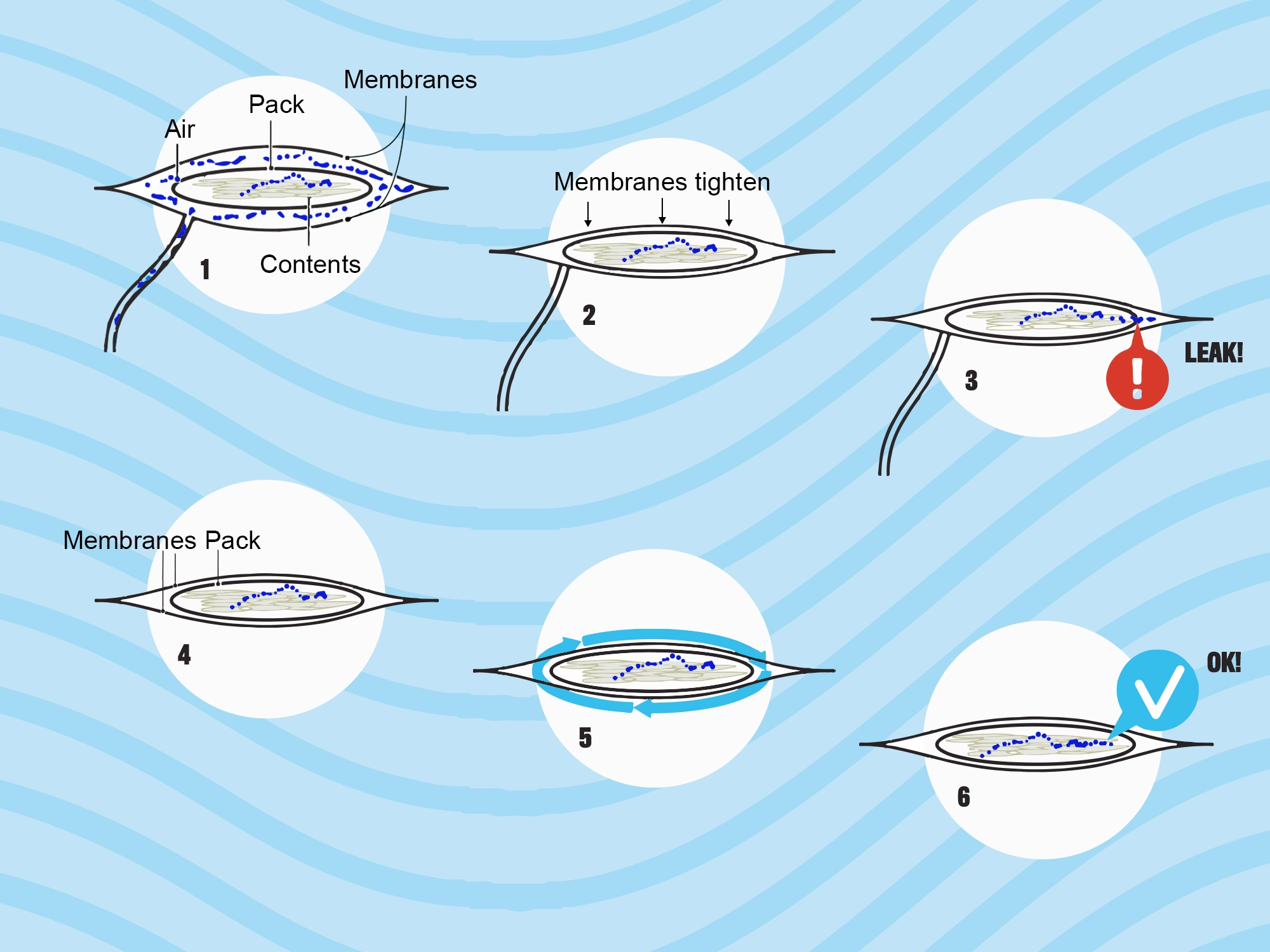
THE PROCESS IN SHORT
- After placing the package in the chamber, closing the lid and pressing start, a deep vacuum will be created by extracting all air in between the membranes.
- The membranes will embrace the pack, protect it from bursting and create a very small measuring space.
- In this small measuring space, we are able to detect micro leaks, as air from the pack will flow out. If a leak is found, it cannot go back into the production line.
- But, of course, there are also leak-tight packaging. How is it that these tested products do not damage? Because an equilibrium is created between the pack and the membranes, so there will be no pressure on the pack.
- A specialized texture on the touch side of the membrane will ensure a constant airflow and potential leaks will not be closed.
- When the pack isn’t leak, it can put back into the production line, as it was not damaged by the leak test.
Our non-destructive leak testing methods ensure less additional costs and combats waste. Let’s work to a world without waste!


